-->
Showing posts with label review. Show all posts

Saturday, September 6, 2008

What is the What (33%)

I'm a very severe critic and few books that I read receive a passing grade. Recently, I've been thinking about my harsh review of Dave Eggers' book What is the What. It's hard to accuse the talented Eggers of taking a thoughtless, imperial approach but here I am.

The story is roughly based on Valentino Achak Deng's life and provides Western readers a way to learn about Sudan without reading Wikipedia. I find it hilarious (in a sad way) that both Eggers and Deng are clearly used to explaining that the book is not about 'Darfur'. My great great grand, Darfur is a region in Sudan where the media lets us know that there is authentic African "ethnic conflict" and "genocide". It is a catchphrase amoung wealthy white people who seek to create meaning in their own lives by toying with the idea of being the saviour of a distant, exotic 'other'. At one point in their life every wealthy white person imagines traveling to a far off land to save the Wretched of the Earth. This is an echo from the age of imperialism when Europeans cast themselves in a morality play as the rescuers of inferior Africans.

There's nothing wrong with caring about strangers but do we have to play make believe? Let's take a look at how What is the What was created.

The book is based on interviews with Deng combined with Eggers' research about the Lost Boys. It's a tough sell since it's a fictionlized memoir. Eggers constructs a character but keeps Deng's real name. What? Why not simply write a truthful biography? Well, in the introduction, Deng claims they turned to fiction because he couldn't faithfully reconstruct his childhood conversations. Smoke and mirrors. Don't trust Deng, he'll say anything to get you to donate to his fund and raise awareness about the plight of his loved ones in Sudan.

And rightfully so. There's something f*cked up going on here. The fact is, Deng's real story wasn't tragic enough. There's a real undercurrent in this novel that Eggers and Deng are selling tragedy. The more horrendous the better. The story is about Deng's difficult life. He experienced terrible things as an adult and as a child. But what's more tragic than him having to watch a childhood friend being eaten by a lion? What if it happens two or three times? The book becomes a sensational highlight reel.
"Sometimes I’d [Eggers] read a human rights report about a certain incident during the civil war, and would ask Val if he knew someone who had experienced that incident, or something like it. Sometimes he did know someone, and we could go from there, but other times I had to imagine it on my own. Some of these scenes were necessary to include, even if Val didn’t have personal experience with them." (see interview)
I think there's a more interesting story about how someone who survives an experience that is clearly traumatic and tragic would have to dress it up to sell it. I'm surprised Eggers wasn't tuned to that frequency. The book sacrifices sincerity for sensationalism. In the end, it encourages us to play imperialist make believe by encouraging us to gawk at tragedy.

*I was moved by the scene with Noriaki Takada's family.

Saturday, June 21, 2008

Review - The Searchers - 19%

I watched The Searchers because it was ranked the number one Western on the AFI's new list of top genre films. So... do Native Americans have rights in the United States? I have a feeling that if this film had presented a different minority in the same way that it treated the Comanche there would be a mainstream outcry each time it was screened. I am shocked that The Searchers is spoken about without any caveat like the permanent introduction attached to screenings of Birth of a Nation: "this is a racist film important for its filming techniques". When I gave my rating of 33% I imagined I would accompany the screening in order to encourage a critical discussion.

Director John Ford was trying to make a movie that plainly showed the racist and genocidal tendencies on the frontier. Sounds interesting, neh? Unfortunately, while he crafts a wide variety of interesting, racist, white characters the Indian characters are shallow, stereotyped plot devices.

The Searchers starts with a Comanche revenge raid -they kill a family and abduct the daughter for assimilation. Thus begins the long search to rescue the youngest daughter from being raised as an Indian. It takes a while but they find her and John Wayne wants to kill her because 'she's gone Comanche' and he hates the Comanche. I liked the film for its darkness. John Wayne is perfect in his role as the racist, cold, frontier savvy tough guy. But don't go thinking that this film has depth. Despite the critics talking about its "deep layers" it's still the heavily sensationalized frontier simulacra so popular in American cinema.

This film has a degree of understanding akin to suburban kids singing along to gangsta rap. They know all the words but they're clueless. Perhaps it was remarkable for its time to include so many Native American words in the screenplay and that brief lament by one white guy about an innocent Comanche woman being killed (clearly the issue is whitey's epiphany and not the dead woman).

Consider this comic relief. A young white man "accidentally" buys an Indian wife in a trade. After trying to scare her off like a wild animal he tolerates her pouring him coffee. Then, upset that she has laid down beside him to sleep he gives her an exceptionally violent kick that sends her rolling down a hill. The music suggests that this is comical and John Wayne laughs.

The film does not cut to her.

The film follows John Wayne and the other white guy talking. In any film, when a character that the audience is trained to care about is injured we immediately cut to them to see that they are all right. She was left off-screen. It was a haunting sign denoting who I was being trained to care about. Amazingly, she is pulled roughly back into the frame as both men begin physically threatening her to tell them where 'Scar' is.

In the end, they go back and rescue the daughter. It's really startling to see her come out of Comanche mode and back to white girl mode as if they're two separate states of being. I'm sure she was instructed to "look like you're waking up from a terrible nightmare". Once again John Wayne wants to kill her for being raised by the Comanche. But he lifts her in the air, recalling a scene at the start of the film, and shows mercy. He shows mercy because he is reminded of her whiteness.

The film ends happily. Except for the Comanche who were killed in the climactic white man's revenge raid. I would have endless respect for this film if it ended with two Indians planning revenge for the senseless murder of their family thus continuing the violent cycle of the frontier but I daresay that this film felt, after all of the superficial criticism, whitey had earned his happy ending.

Sure you can study it for cinematography or storytelling technique but it's purpose is no more noble than sheer entertainment. In the end, The Searchers could only be popular in a state where Native Americans are second class citizens.

This essay gets it, why can't everyone?

Friday, June 6, 2008

My Name is Rachel Corrie - Review

I thought this play was a worthy project. It was based on the journals of Rachel Corrie, the 23-year-old American woman killed by an Israeli bulldozer while protesting the destruction of a Palestinian settlement.

I recently watched this production (made famous in Toronto by the controversy caused when it was rejected by CanStage). Unfortunately, I was so excited to see this piece that I came up with a better play in my head as was disappointed by what I saw.

What I saw:
The first half of the play was terribly boring. I didn't know what was more painful: the relentless misfiring jokes or watching Corrie's life being ruthlessly pounded into the mold of "typical American girl". Her relationship with her parents was wonderfully sophisticated but so misunderstood. Corrie was being played below the intelligence of her dialogue. It's a one-woman show and while Bethany Jillard held her weight she had a tendency to shout her lines -like a high schooler who "turns on" their acting. This poor choiceto show youth (I hope it was a choice) was dropped for the second half of the play. Corrie talks about life in Rafah, the horrors of civilian lives amidst military conflict, and her resolution that she is doing good in the world. The play collapsed under the weight of its politically charged content. There's a lot of talk about it being a simple story about a passionate young girl in a mad mad world but it's clear that it's written to raise awareness of the suffering of Palestinian civilians as a result of the state of Israel's security policies. It's part tragedy and part journalism and it does neither effectively.

The play in my head:
My version is a story about the politics of youth: the mix of inspiring idealism and pathetic naivety -not the Palestinian-Israeli conflict.

First:
drop any pretense of fair representation of the Palestinian-Israeli conflict and show Corrie at her most indignant and righteous. The play I saw was boring because it tried to remove her bias and show a safe, watered-down version of her politics. It was embarrassing that this tame play is considered controversial. She was a political radical. I want the audience to see and feel that.

Second: show a more realistic and flawed Rachel Corrie. I say this because, looking between the lines of the play, she struck me as an interesting outsider. Intelligent, passionate, and an introverted journal writer. She has no lasting friends in the play (other than her parents) and the only suggestion of an intimate relationship looks like it was based upon an exaggerated fantasy in her journal. I was very interested in the final video played. Who put those words in her mouth? How do so many children develop their "save the world" perspective?

Third: Show her to be naive, childish, and desperate. She's an American girl traveling abroad to
police the globe. Be honest. Her desire to save the world is rooted in her self-esteem and attempt to make friends (my bias is that human life is most often a struggle for the individual to be accepted by the group on their own terms). There's also an edge of wanting to be an exotic freedom fighter. I have spoken with many high school students with an imperial "I Must Save Africa" worldview. It provides a moral high ground in the hopes that others will look up to them (I have seen this backfire -striving to be an inspiring mini-Gandhis can push others away by making them feel guilty or inferior).

Fourth: Now that the audience has dismissed her as flawed and misguided, show her courage and the difference she makes. Whatever her flaws, Corrie took risks, made sacrifices, and stood up. She never resigned herself to thinking violence cannot be stopped. Maybe she's compensating for first world white guilt but what of it? She used her life to protect civilians in a conflict. There is a profound frustration in Corrie about the world we live in and wisdom in the awareness that we are the ones choose it. My play would leave audiences with the following feeling:

That girl was embarrassingly naive but what the f*ck have I done with my life? When did I give up? If the audience carried that sentiment into learning about the Palestinian-Israeli conflict then I would consider my work worthy.

When Werner Herzog's doc "Ballad of the Little Soldier" was accused of criticizing the Sandinista rebels (in the Nicaraguan conflict in the 1980s), he responded that he was not making a political film. He was trying to tell the story of child soldiers. My own view is that everything is political -everything is about power and choosing a side. But I prefer Herzog's approach to storytelling: listen to now and speak to forever.

Saturday, May 24, 2008

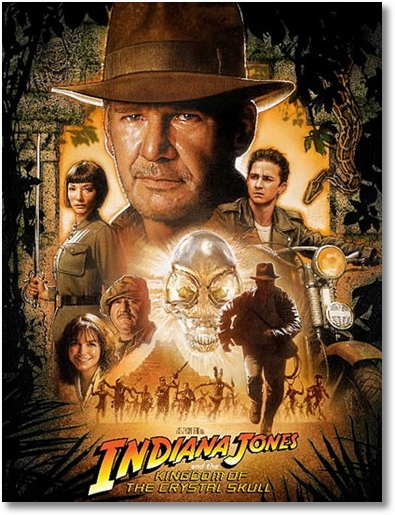
Indiana Jones and the Kingdom of the Crystal Skull - 24%

Do not go see Indiana Jones 4.
I know. It hurts me too. I'm a fan of the all of the players, Lucas, Blanchett, Ford, Spielberg but they dropped the ball, big time. I thought it was a bad movie. My friends responded with:

"I didn't walk out."

and
"I didn't check my watch."

This led to a funny conversation about bad movies. Is it worse if a movie causes you to walk out and save an hour and a half of your life or strings you along for two hours only to end in disappointment because it never actually got better?

In case you think we're elitist, the masses had a similar reaction. I saw this movie with a full theater and we didn't all laugh, gasp in fright, or cheer in unison once. Sometimes people hurrayed in desperate support when they saw a reference to an earlier film. My friend said:

"I made a sound once."

That is my official review of this film.

If you have been left with intense feelings of dissatisfaction then I hope you find this informative -I've identified exactly why this movie failed miserably for me. I feel that if my criticism is articulate then some good can come of this mess.

Additionally, I understand that the film is "just a summer blockbuster" (I have little understanding why it played at the Cannes Film Festival) but there is a definite art to making an action film and the film had the following failings:

No running jokes.
In fact, all of the dialogue is uninspired. Even the required exposition (we need to go to Peru to get a Crystal Skull before they kill this old guy and my mom) is delivered terribly. We all know a Hollywood action movie needs to spell out the plot in a couple lines. But it can still be fun, memorable, and quotable. The exposition in this film was flat and lazy.

Glaring plot holes.

This really made it feel like Spielberg, Lucas, and Ford were just laughing at what sucker-audiences will soak up. In the second scene of the film, Indiana Jones has to describe the villain to the FBI. They present a secret file that introduces her name. There's only one problem, in the first scene she already introduced her name in a monologue and Indy says it aloud to remind the audience. Sloppy film making. Surely a screenplay needs to be tighter than that? I don't consider myself having an exceptional eye for continuity but I did notice that in the great action sequence of the movie Indy and his crew are in a car chasing after the villain -who is escaping with the prize. But in the next shot, the villain is chasing them. What? Albeit most people will miss this because of the terrible choices made in that action sequence.

Terrible action sequence choices.
The memorable action sequence of the film is the jungle car chase that involves a swordfight. Sound great? It was. Only they also tacked on two dreadful choices within the same sequence. The first involves one character getting hit in the genitals and the other involves him swinging on vines alongside his new found monkey friends to catch up with the car cahse (I sh*t you not this happens). These were cartoonish additions that seemed like rejected ideas from a Kangeroo Jack sequel. In the beginning of the film they keep returning to a computer generated gopher in the desert. It was as endearing and comical as the grotesque beavers that Bell Canada uses in their advertising to try and reduce their market share.

Heartless action.

The action is well-shot but meaningless. There are no layers. No one is struggling with anything. No one is forced to choose between the prize and the people they love. Surprisingly, the action sequences lack any sign of suspenseful parallel action. You know how good movie cut back and forth? The hero struggles, then we see the sidekick struggling. Then to the hero and things are bad, then to the sidekick and the situation is worse. Then they both begin to turn the tide, say something witty, and help each other out. In this film action happens very plainly -one thing at a time.

What's worse. There is no character in the action sequences. There's no emotional layers. I remember enjoying the subtext to the Indiana Jones 3. Most action sequences are clearly underscored as a competition of bravado between the father and the son. But this film is emotionally dead. Also, Shia Labouef's character is a tough guy but he cries a lot and has no trouble having everyone see him cry. I'm fine with that but it doesn't cause any tension. It would have been nice if Indy wanted him to "man up" or, at the very least, if he tried to hide his tears. Give me anything between the characters. Please.

Plot.
I was willing to suspend my disbelief for the use of aliens in the movie. But the plot was terrible. Good stories give the viewers a chance to guess what is going to happen. This movie used "magic" too much. The problem with magic is that it explains itself. There's no game being played, I'm not given a chance to guess anything. At one point the only thing moving the plot forward is Indy who basically says: I have to keep going, the alien technology has hypnotized me. Bullsh*t motivation. They could have played an undercurrent of Indy's potentially unhealthy obsession with archeology and if he was becoming like his father. But in this movie the writer shows no understanding that a movie can be interesting and good.

There are no stakes.
Nothing is ever really on the line. No relationships are threatened and none of the characters' lives are put in any danger. No one even gets hurt. There's no adrenaline in the movie. Some nice special effects if you've never seen CGI.
Performances.
They were fine. Ford wasn't too old. Blanchett's villain wasn't irritatingly sexualized. This was more of a case of nothing for the actors to work with.


Awkward Racism.
I would have had this criticism even if the film was good. There's something really creepy about the common sci-fi staple that the Mayans were helped by aliens. I never hear about aliens coming down to explain irrigation to white people. The "native warriors" is like an awkward cameo from a more racist age. They have no dialogue, only war cries and they all look the same. an exotic costume designer's dream.

Friday, May 9, 2008

My Top Movies - By Percent

Can you really assign a number to art? Yes.

93
Downfall
93 Godfather
93 Unforgiven
91 Dogville
89 The Usual Suspects
89 All Quiet on the Western Front (1979)
88 The Iron Giant
88 Fight Club
88 American History X
87 Run, Lola, Run
86 Edward Scissorhands
86 Resevoir Dogs
86 Leon (The Professional)
86 Total Recall
86 The Shawshank Redemption
85 Cool Hand Luke
85 Night of the Living Dead (1990)
84 American Psycho
84 Dumb and Dumber
83 Master Harold... and the Boys
82 The Descent
81 Groundhog Day
81 The Program
81 Return to Oz
80 Twelve Monkeys
80 Se7en
80 The Ring

Wednesday, February 27, 2008

Freakonomics

63%
Not Recommend
A quality idea for a book but you don't need to read it. A summary is as effective. Tough to say since the writing is articulate but the authors didn't give me enough credit.

Is Steven Levitt impersonating Bill Gates or vice versa? Do smart people get together and agree what to look like?

The book has an aggressive opening that is packed with interesting ideas. Unfortunately it's the attention-grabbing introduction and the rest of the book repeats itself. It's about the "genius" economist Stephen Levitt. The guy is great. He has an interest in crime and an economist's reliance on numbers to tell the story.

It connects Roe vs. Wade, the landmark American case about the right to have an abortion, with the decline in crime rate in the United States. The authors claim the connection caused a lot of controversy because economists don't care about politics only what the data tells them. The argument is that most reported criminal behaviour, especially drug trafficking, robbery, and murder, is from people in poverty. Since poor people were having less babies (read: more abortions) there was less of a population base for criminals to appear.

There. I summed up the idea almost as nicely as they do at the start of the book. Unfortunately, the book continues and they take 100 pages to say the same thing again. That might have been interesting but the data and analysis are given in such a watered-down, user-friendly way that it was boring.

The rest of the book tries to be a highlight reel of social economic theories. That is, using data and an understanding of incentives to explain cheating in sumo wrestling as opposed to interest rates. They coin the phrase "freakonomics" to create a theme for the book: turning an economist's eye to untraditional problems. They might as well have called it "thinking". The only topics covered in the book are: how the funding model in the US encourages teachers to cheat for their students on standardized test. Why sumo wrestlers occasionally let each other win. Abortion's effect on crime. And how rich people set the trends in first names.

I'm glad I read this book since I trust the intelligence of the friend who recommended it to me so, bare minimum, I get to hear what he liked about it.